Ever wonder if that battery drawer is full of dead weight or hidden gems? Before you toss those AAs, 9Vs, or D cells, take 30 seconds to test them with a voltmeter. You’ll save money, reduce e-waste, and finally know which batteries actually work.
In this guide, I’ll show you exactly how to test household batteries using a digital voltmeter (also called a multimeter). No technical background needed—just a few simple steps and you’ll be confidently sorting the good from the bad.
Safety First
This guide covers household batteries only: AA, AAA, C, D, and 9V alkaline or rechargeable batteries.
Do NOT use this method for:
- Car batteries (12V automotive)
- Power tool battery packs (lithium-ion packs)
- Damaged, swollen, or leaking batteries
- Any battery that looks physically compromised
If you’re unsure, err on the side of caution and recycle the battery properly (more on that below).
What You’ll Need
- Digital voltmeter/multimeter (basic models work fine, often under $20)
- Batteries to test
- Optional: Pen and paper or masking tape to label tested batteries
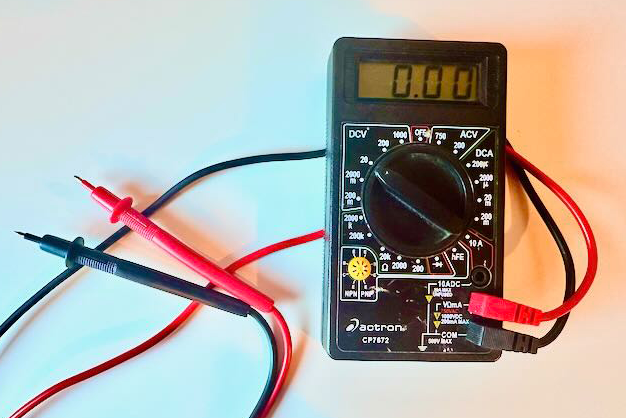
Setup Your Voltmeter
Before testing, you need to connect your voltmeter probes correctly:
- BLACK probe → COM port (the common/ground port)
- RED probe → VΩmA port (voltage/resistance/milliamp port)
Note: You’ll notice a third port labeled 10ADC or 10A. This is for measuring high current (0-10 amps) and is NOT needed for battery voltage testing. Leave it empty.
Testing Procedure
Now let’s test your batteries:
Set your voltmeter to DC Volts (look for the V⎓ symbol or “DCV” setting)
Select the appropriate voltage range:
- For AA, AAA, C, or D batteries: Use the 2V-20V range
- For 9V batteries: Use the 20V range
If your meter has auto-ranging, it will select this automatically.
Touch the probes to the battery terminals:
- BLACK probe → Negative (−) end (usually the flat end)
- RED probe → Positive (+) end (usually the raised button end)
- Read the voltage displayed on the screen
That’s it! Now let’s interpret what those numbers mean.
Understanding Your Results
Here’s a quick reference guide for common battery types:
| Battery Type | Nominal Voltage | Good Condition | Weak | Replace It |
|---|---|---|---|---|
| AA / AAA | 1.5V | > 1.4V | ~1.2V | < 1.2V |
| C / D | 1.5V | > 1.4V | ~1.2V | < 1.2V |
| 9V | 9V | > 8.5V | ~7.5V | < 7.5V |
Important caveat: This no-load testing gives you a “best case” reading. A battery might show good voltage when tested this way but still fail under actual use (when powering a device). For more accurate results, test the battery under load—but that requires additional equipment and is beyond the scope of this quick guide.
For rechargeable batteries (NiMH): Nominal voltage is 1.2V instead of 1.5V. Replace rechargeable batteries when they drop below 1.0V.
Troubleshooting Common Issues
Negative reading (like “-1.47V”): You’ve reversed the probes. Swap them—BLACK on negative, RED on positive. The reading will then be positive.
Fluctuating or unstable reading: Make sure the probes are making firm contact with the battery terminals. Dirty or corroded battery terminals can cause poor contact. Try cleaning the terminals with a cloth or eraser.
No reading at all:
- Check that your voltmeter is turned on
- Verify you’re in DC Volts mode (V⎓), not AC Volts (V~)
- Ensure probes are firmly plugged into the correct ports
- Try a fresh battery you know is good to test if the meter is working
Reading is way off: Double-check that you’ve selected the correct voltage range. If you’re on the 200mV range instead of 20V, your reading will be incorrect.
What to Do with Dead Batteries
Found a drawer full of duds? Don’t toss them in the trash.
Batteries contain harmful materials and should be recycled properly. Many retailers (like Home Depot, Lowe’s, Best Buy, and Staples) offer free battery recycling drop-off. You can also check Earth911.com to find local battery recycling centers near you.
Some municipalities also offer battery recycling through their household hazardous waste programs.
Wrap Up
Testing batteries with a voltmeter takes less than a minute and can save you from buying new batteries you don’t need. Keep that voltmeter handy, give your mystery batteries a quick check, and you’ll always know what’s worth keeping.
Now go rescue some perfectly good batteries from the junk drawer!
Comments