Part of the AWS re:Invent 2025 Series: Overview | Day 1 | Day 2 | Day 3
9:00AM KEY004: Infrastructure Innovations Keynote
Speakers: Peter DeSantis, SVP AWS & Dave Brown, VP of Compute and MLS
Dive deep into the technology that powers AWS services. Get a closer look at how AWS’s unique approach and culture of innovation create leading-edge solutions, from silicon to services.
Announcements
Compute & Custom Silicon
AWS Graviton5 (Preview) - Next-Gen ARM Processor
AWS’s latest custom ARM processor delivers significant improvements:
| Spec | Graviton5 | Improvement |
|---|---|---|
| Cores | 192 | Custom cloud-optimized |
| L2 Cache | 2x | vs Graviton4 |
| Compute | 25% faster | vs M8g instances |
| Database | 30% faster | vs previous gen |
| Web/ML | 35% faster | vs previous gen |
Architecture:
- Built on AWS Nitro System with hardware and software innovations
- Custom designed specifically for cloud workloads
- Available in EC2 M9g instances (preview)
Ideal Workloads:
- Application servers and microservices
- Gaming servers
- Midsize data stores
- Caching fleets
- Machine learning inference
Trainium3 Updates
Additional details from the keynote:
- Trainium PyTorch native support - First-class framework integration
- 4.4x higher performance vs Trainium2
- 5x Higher Tokens/MegaWatt efficiency
- Apple Swift demo showcased performance on Graviton
Trainium4 - Coming Soon
Next generation announced, continuing AWS’s aggressive custom silicon roadmap.
Serverless Evolution
Lambda Managed Instances
A new deployment model that combines serverless simplicity with EC2 flexibility:
- How it works: Lambda runs on EC2 instances in your account
- Provisioning: Lambda handles all provisioning automatically
- Benefits:
- Access specialized compute options (GPU, custom instance types)
- Optimize costs for steady-state workloads
- Maintain serverless development experience
- No infrastructure management required
This bridges the gap between Lambda’s simplicity and EC2’s flexibility, ideal for workloads that need specialized compute but want serverless operations.
Project Mantle (Bedrock Redesign)
Internal AWS initiative revealed during the keynote:
- Key insight: “Inference needs a different architecture”
- Focus: Redesigning Bedrock’s architecture specifically for LLM inference workloads
- Goal: Optimized performance and efficiency for generative AI inference
- Signals AWS’s continued investment in purpose-built AI infrastructure
Vector Search & AI Infrastructure
Nova Multimodal Embeddings
New embedding capabilities for multimodal content—combining text, image, and video understanding.
S3 Vectors - Enhanced Performance
Building on the GA announcement, additional performance details:
- Pre-compute approximate nearest neighbor (ANN) search
- Sub-100ms queries over 2TB of vector data
- Optimized for AI agent memory and context enhancement
OpenSearch Vector Search
Continued performance improvements for vector database workloads.
TwelveLabs Demo
Customer showcase demonstrating AI video analysis:
- Turns hours of video into structured, searchable data
- Example of AI/ML infrastructure enabling new use cases
11:00 AM - INV205: Reinventing Software Development
Speaker: Deepal Singh - VP of Developer Agents, AWS
The rise of AI coding and autonomous agents is transforming how developers work—enhancing productivity, improving flow state, and making development more intuitive.
Key Topics
Kiro - Autonomous Development Agent
Deep dive into Kiro’s capabilities:
- Spec-driven development - Define requirements in natural language, Kiro implements
- Property-based testing - Automated test generation based on specifications
- Plans and executes multi-step coding tasks
- Works across multiple repositories
- Learns from your reviews and maintains context
Kiro Powers - Dynamic AI Context System
A breakthrough in AI agent capabilities—dynamic, context-aware integration that provides instant access to specialized knowledge for any technology.
Core Innovation:
- Tools load only when relevant to current task
- Prevents context overflow by activating powers selectively
- Minimal baseline context usage until needed
How It Works:
- Mention “database” → Supabase power activates
- Loads specific MCP tools for database work
- Switches context automatically when task changes (e.g., moving to deployment)
Launch Partners:
- Datadog, Dynatrace (observability)
- Figma (design)
- Neon, Supabase (databases)
- Netlify (deployment)
- Postman (APIs)
- Stripe (payments)
- Strands Agent (AI agents)
Vision: A model for continual learning where AI agents can expand capabilities dynamically, automatically update with framework changes, and learn specialized knowledge without overwhelming the system.
3:30PM KEY005: Closing Keynote - Dr. Werner Vogels, VP & CTO (Amazon)
Dr. Werner Vogels, Amazon.com’s VP and CTO, delivered his fourteenth and final re:Invent keynote. Rather than product announcements, Werner presented a philosophical exploration of how developers must evolve in the age of AI.
Overview
Central Question: Will AI take my job? Will AI make me obsolete?
Werner’s Answer: We evolve, and so must your tools. The work is yours, not the tool’s.
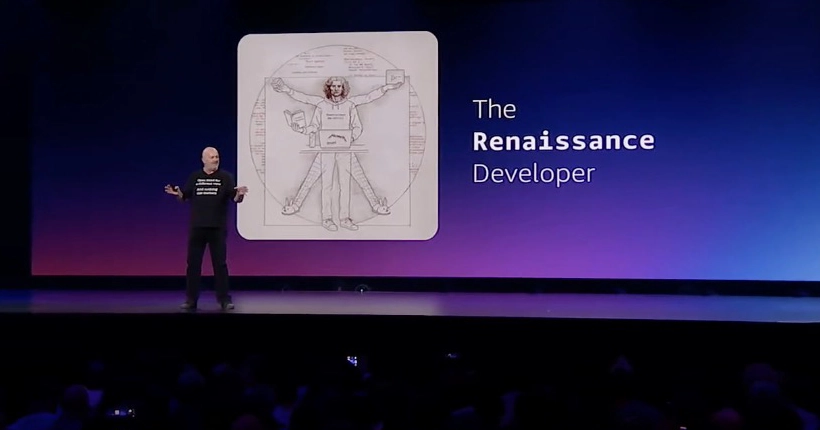
Werner introduced the “Renaissance Developer” framework—5 principles for thriving alongside AI tools.
The Renaissance Developer Framework
1. Be Curious
Takeaway: Curiosity leads to learning (and invention)
- Experimentation & willingness to fail are essential
- Yerkes-Dodson Law - Optimal performance requires the right level of arousal/challenge
- Learning is social—engage with communities
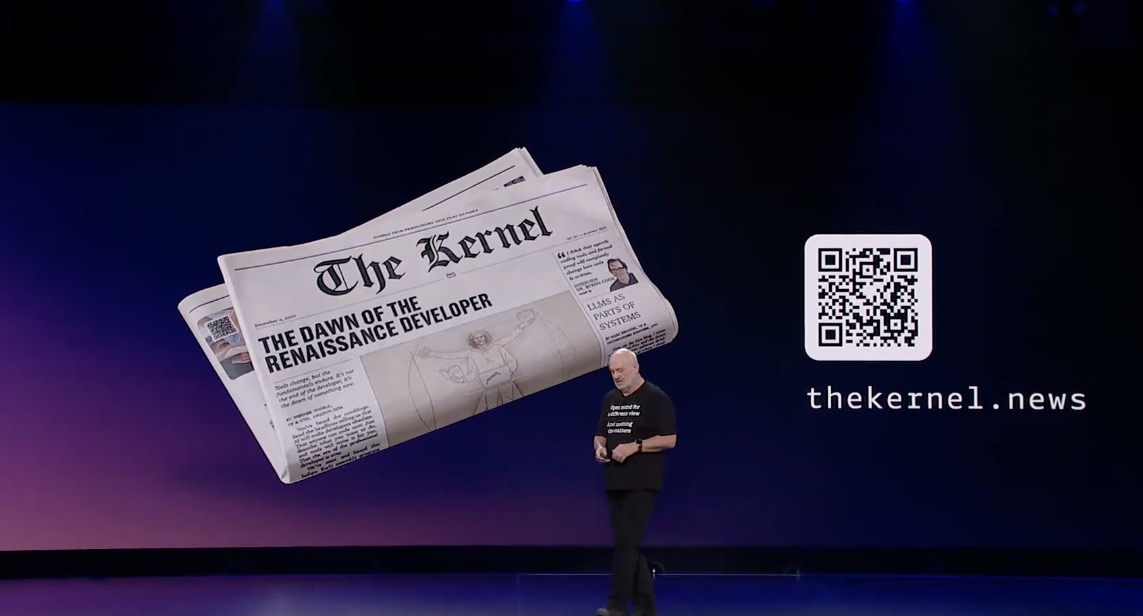
- thekernel.news - Werner Vogels’ personal newsletter on technology and innovation
2. Systems Thinking
Takeaway: Think in Systems, not isolated parts
“A system is a set of things…interconnected in such a way that they produce their own pattern of behavior over time.” — Donella Meadows, Thinking in Systems
Recommended Reading:
- Leverage Points: Places to Intervene in a System - Donella Meadows
Understanding leverage points helps you identify where small changes create significant impact across complex systems.
3. Communication
Takeaway: Clearer communication reduces mistakes
- Specifications remove ambiguity
- Specification-driven development is the future of AI-assisted coding
Resources:
- Understanding Spec-Driven-Development: Kiro, spec-kit, and Tessl - Martin Fowler
- Spec-driven development with AI: Get started with a new open source toolkit - GitHub Blog
When you communicate requirements clearly through specifications, AI tools can implement more accurately and developers can verify correctness more easily.
4. Ownership
Takeaway: You build it, you own it.
The work is yours, not the tool’s. AI introduces new challenges that require developer ownership:
- Verification Debt - AI generates code faster than you can understand it. Review takes longer.
- Hallucination - AI can confidently produce incorrect code
You must own and verify everything AI generates. The responsibility doesn’t transfer to the tool.
5. Polymath
Takeaway: Broaden your “T”
Developer Types:
- “I” Shaped - Deep knowledge in one area only
- “T” Shaped - Deep knowledge in one area + general knowledge across many areas
AI tools amplify your capabilities across domains you may not be expert in. To leverage this effectively, you need breadth of knowledge to:
- Recognize when AI output is reasonable
- Know what questions to ask
- Connect insights across different domains
Werner’s Parting Wisdom
AI changes the tools, not the work. The Renaissance Developer:
- Embraces curiosity - Continuously learning and experimenting
- Thinks in systems - Understanding interconnections and leverage points
- Communicates clearly - Using specifications to remove ambiguity
- Takes ownership - Verifying and owning AI-generated code
- Broadens knowledge - Becoming a polymath to leverage AI effectively
“Broaden your T” — become a polymath who combines deep expertise with wide-ranging knowledge.
Return to: AWS re:Invent 2025 Overview →

Comments